Tips to identify rush skeletonweed, county's newest noxious weed
Published on May 27, 2026
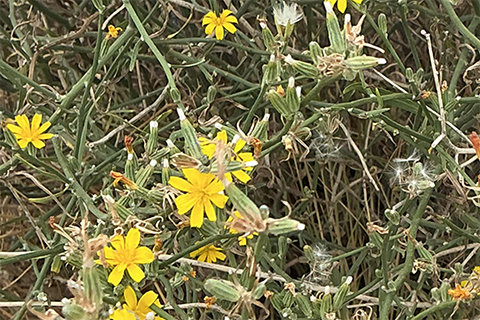
First reported in the May 12 edition of the County Roots newsletter, rush skeletonweed is a new noxious weed in Weld County. While the weed division of the Weld County Department of Public Works is working on removing the species and limiting its spread, it’s also asking for the public’s help in reporting sightings. As many weeds look similar to rush skeletonweed, the weed division has some additional tips to assist land and property owners in spotting the weed.
“Early reporting is helpful, and we appreciate residents keeping an eye out and sending photos,” said Tina Booton, Weld County Weed Division Supervisor. “But several yellow flowers — prickly lettuce, snowthistle, dandelion-type plants, and other roadside mustards — look similar to rush skeletonweed so we want to share some specific characteristics of the plant to help identify it.”
A few clues to help with rush skeletonweed identification
- The plant has thin, wiry, branching stems that can look almost leafless. Its yellow flowers are usually small and dandelion-like with seven to 15 petals.
- When broken, the plant has a milky sap. One of the best identifying characteristics is the presence of coarse, downward-pointing hairs near the lower part of the stem.
- Other plants, such as yellow mustards, have more obvious flower patterns and a different flower shape with four petals.
“We encourage people to be on the lookout for rush skeletonweed and work with our weed division to identify it,” said Kevin Ross, Weld County Commissioner Coordinator of Public Works. “Even if a plant turns out not to be rush skeletonweed, reports are still helpful. We’d much rather check a lookalike than miss a new infestation.”
Those who believe they’ve spotted rush skeletonweed should call the weed division before pulling or treating the plant to avoid misidentification. Booton can be reached at 970-400-3770 and Kathy Griffee, Weld County Weed Landowner Specialist, can be reached at 970-400-3772. Booton encourages people to take pictures of the whole plant, including close-up photos of the flowers, leaves near the base, the stems, and any seed heads.
Learn more about and view pictures of rush skeletonweed.